Can being uninsured affect my own injury claim?
Reviewed by Andrew (Andy) R. Gillin
California State Bar #45226 ↗ · Approval recorded November 4, 2026
How we record review approvalYes. If you drove without insurance, state law may limit what you can claim for pain and other nonfinancial harm. This can apply even when the crash was not your fault.
In this guide
Here’s an example
A car owner has no insurance. Another driver hits them. They need to check which losses they can claim.
A made-up example to explain the idea. Your facts may lead to a different answer.How the rule works
Civil Code section 3333.4 limits some claims for pain and other nonfinancial losses. It applies in certain motor vehicle cases. Bills and lost pay are different types of losses. The law has exceptions.
Legal references: [1] Civil Code § 3333.4 — Limits on certain damages
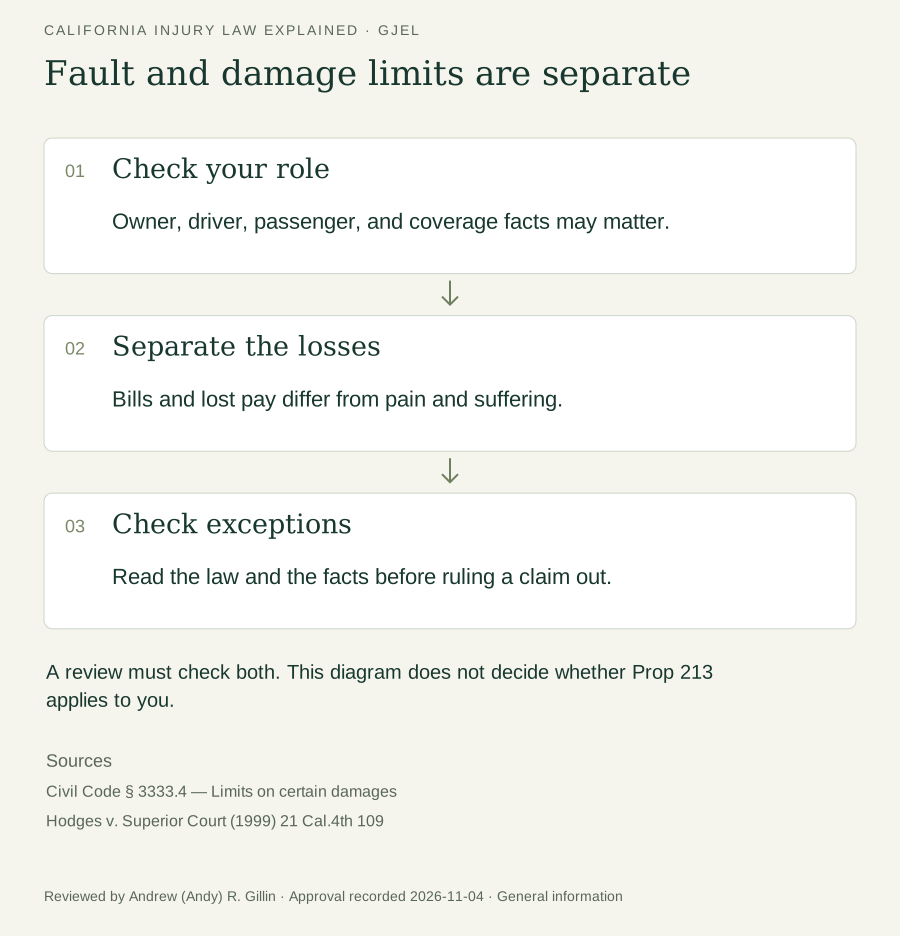
Fault and damage limits are separate
Check your role
Owner, driver, passenger, and coverage facts may matter.
Separate the losses
Bills and lost pay differ from pain and suffering.
Check exceptions
Read the law and the facts before ruling a claim out.
A review must check both. This diagram does not decide whether Prop 213 applies to you.
What does Prop 213 mean?
Prop 213 is the name often used for the law behind these damage limits. Civil Code section 3333.4 can bar certain people from claiming money for pain and other nonfinancial harm after a motor vehicle event.
This is different from proving fault. A driver may have caused the crash, yet a separate rule may limit some damages claimed by an uninsured person. Your role as an owner, driver, or passenger matters.
Sources: [1]
Do not confuse a coverage-based damage limit with how shared fault works.
To understand the type of loss at issue, read pain and suffering damages.
Keep the kinds of loss separate
Medical costs and lost pay are financial losses. Pain and loss of enjoyment are different. A limit on one kind of loss does not, by itself, answer every part of the claim.
The statute has exceptions. Hodges also addresses a narrow claim about a car’s unsafe design. That decision is not a general exception for every uninsured driver.
For financial harm, compare medical costs in an injury claim.
Keep separate records for proof of missed work.
What can change the answer?
The rule applies to certain people and has exceptions. It does not mean every person without insurance has no claim. Bills and lost pay need a separate review.
Questions people ask
Does having no insurance mean I have no injury claim?
No. It can limit some damages in covered situations. It does not settle all questions about fault, financial loss, or exceptions. Get the exact role and facts checked.
References: [1]
Can I use the Hodges case for any car crash?
No. It dealt with an unsafe-design claim against a car maker. A claim that another driver drove carelessly is a different setting.
References: [2]
Court decisions behind this answer
A case can help explain a rule. Its facts and limits matter too.
Hodges v. Superior Court
Supreme Court of California · 1999
21 Cal.4th 109, pp. 111–113
The court let a claim about a car’s unsafe design proceed despite the driver’s lack of insurance. The damage limit did not apply in that setting.
That is not the rule for every crash claim. A claim based on careless driving needs its own review.
Case applicability reviewed as recorded above.
A useful next step
Ask a lawyer to check your role, your coverage, and the crash facts.
If you are unsure which rule applies, a lawyer can review your facts and any deadlines. Learn about GJEL’s injury representation.
The law behind this guide
The references below support the legal discussion. Their application depends on the facts.
- Civil Code § 3333.4 — Limits on certain damages ↗Statute · Review recorded above
- Hodges v. Superior Court (1999) 21 Cal.4th 109 ↗Case law · Review recorded above
Updated 2026-11-04. Read our editorial standards.