Can I have a claim if I was partly at fault?
Reviewed by Andrew (Andy) R. Gillin
California State Bar #45226 ↗ · Approval recorded November 4, 2026
How we record review approvalYou may still have a claim when you share some blame. California generally uses comparative fault: your share of fault can reduce what you recover.
In this guide
Here’s an example
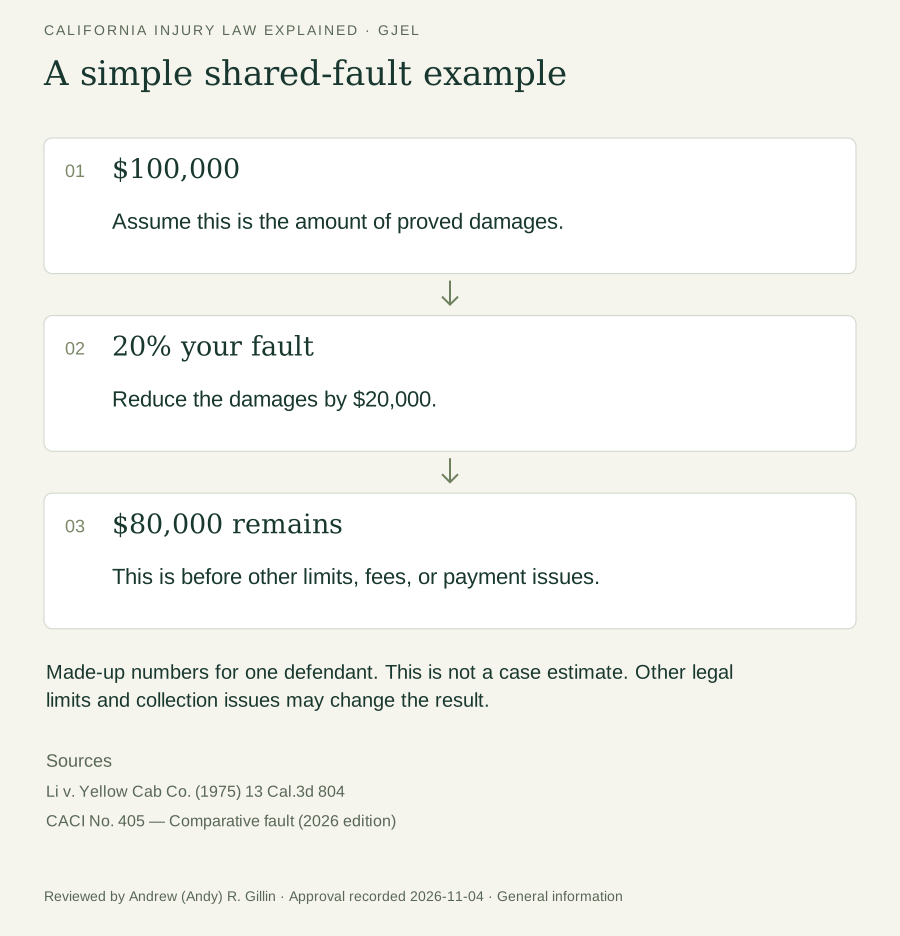
In a simple case with one defendant, a jury finds $100,000 in damages and 20% fault for the injured person. The reduction leaves $80,000 before other limits or deductions.
A made-up example to explain the idea. Your facts may lead to a different answer.How the rule works
Courts use rules called comparative fault to divide blame. The rules for splitting bills may differ from those for pain and other nonfinancial harm. More than one party may owe money.
Legal references: [1] CACI No. 405 — Comparative fault (2026 edition) · [2] Civil Code § 1431.2 — Noneconomic damages and fault
A simple shared-fault example
$100,000
Assume this is the amount of proved damages.
20% your fault
Reduce the damages by $20,000.
$80,000 remains
This is before other limits, fees, or payment issues.
Made-up numbers for one defendant. This is not a case estimate. Other legal limits and collection issues may change the result.
How does comparative fault work?
Comparative fault means that more than one person can share blame. California uses a rule often called pure comparative negligence. In a covered negligence claim, your share of fault can reduce your damages rather than bar the whole claim.
For a simple made-up example, assume one defendant, $100,000 in proved damages, and 20% fault assigned to you. A 20% reduction leaves $80,000 before other issues. This is math to explain the rule, not an estimate of any real case.
The percentage must rest on facts. Read how to prove what caused the harm.
Fault, damages, and payment are different
First ask what each person did. Then ask what harm the acts caused. The amount that can be collected can raise more questions about insurance, other defendants, and damage limits.
Li changed the old all-or-nothing rule for negligence claims. It does not supply a fixed percentage for a rear-end crash, a bike crash, or any other event.
A case with several defendants has more allocation rules. See claims with more than one at-fault person.
For losses and payment sources, read what affects claim value.
What can change the answer?
A percentage is not set by what an adjuster says. The evidence matters, and some claims have special rules.
Questions people ask
Who decides the fault percentage?
The parties may dispute it during a claim. If the case is tried, the fact finder decides based on the proof and instructions. An adjuster’s first view is not the same as a final court decision.
Court decisions behind this answer
A case can help explain a rule. Its facts and limits matter too.
Li v. Yellow Cab Co.
Supreme Court of California · 1975
13 Cal.3d 804, pp. 827–829
A person can share fault and still have a negligence claim. Their share of blame can reduce the recovery.
This does not set anyone’s fault percentage. Other limits and defenses can still matter.
Case applicability reviewed as recorded above.
A useful next step
Keep evidence that shows what each person did. Avoid guessing about your share of blame.
If you are unsure which rule applies, a lawyer can review your facts and any deadlines. Learn about GJEL’s injury representation.
The law behind this guide
The references below support the legal discussion. Their application depends on the facts.
- CACI No. 405 — Comparative fault (2026 edition) ↗Jury instructions · Review recorded above
- Civil Code § 1431.2 — Noneconomic damages and fault ↗Statute · Review recorded above
- Li v. Yellow Cab Co. (1975) 13 Cal.3d 804 ↗Case law · Review recorded above
- California Courts — Civil lawsuits ↗Court guidance · Review recorded above
- Evidence Code § 669 — Presumption based on violation of law ↗Statute · Review recorded above
- Civil Code § 3333 — Compensation for harm ↗Statute · Review recorded above
Updated 2026-11-04. Read our editorial standards.