What if the other driver does not have enough insurance?
Reviewed by Andrew (Andy) R. Gillin
California State Bar #45226 ↗ · Approval recorded November 4, 2026
How we record review approvalYour own underinsured motorist coverage may help. It can apply when the driver who hurt you has too little insurance. It does not always add both policy limits together.
In this guide
Here’s an example
A person’s losses are more than the other driver’s policy can pay. They check their own auto policy for help.
A made-up example to explain the idea. Your facts may lead to a different answer.How the rule works
Underinsured motorist claims have rules about the other policy’s payment and your own limits. The coverage is not a simple extra pot of money. A release may affect the steps you can take next.
Legal references: [1] Insurance Code § 11580.2 — Uninsured motorist coverage · [2] California Department of Insurance — Automobile insurance guide
Check the gap before you settle
Other driver’s policy
Check its limits and the proposed payment.
Your own UIM policy
Check limits, terms, and required steps.
Covered loss
Compare the proof and payments. Do not just add limits.
This is a review path, not a formula for your recovery. The policy and legal steps still control.
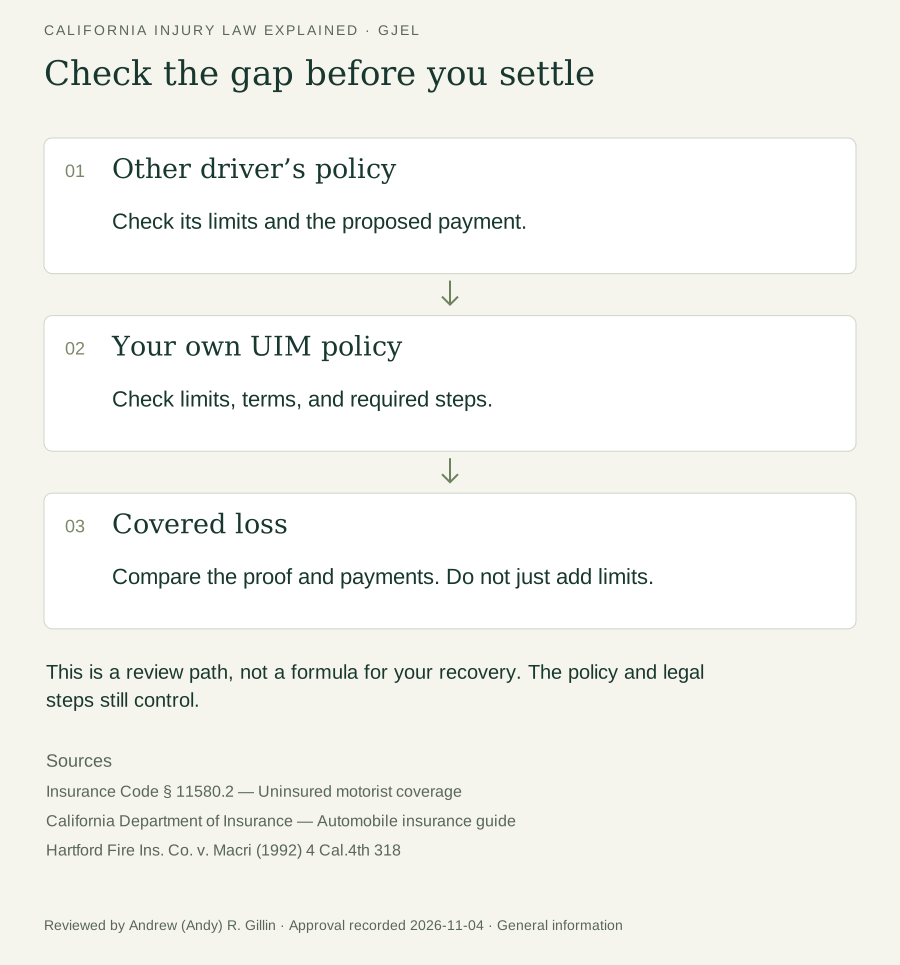
Two policies do not always add together
Underinsured motorist coverage is often called UIM. It can matter when the at-fault driver’s injury limit is below your own UIM limit. The claim must still fit the law and policy.
Do not add the two policy limits and treat the total as money you will get. Prior payments can reduce what remains. You must also prove the covered loss. Limits are ceilings, not a case value.
The amount of harm is a separate issue. Read what affects an injury claim’s value.
For the policy labels, see how standard policy limits work.
Review the next step before a release
Keep the other policy’s offer, its limits, your own policy, and all proposed releases together. Ask what payment or proof is needed before the UIM claim can move forward.
Macri explains why a rule for one type of motorist coverage cannot simply be copied to another. It is not a reason to sign a release before checking your own claim.
Before you sign, read what a settlement release gives up.
If there is no insurance at all, compare uninsured motorist coverage.
What can change the answer?
The limits and terms matter. Money paid under one policy can affect what the other pays. Some steps must happen before you settle with the other driver.
Questions people ask
How long does it take to find out the coverage limits?
There is no fixed answer for every claim. Records, policy terms, and who may be responsible can affect the review. Ask what is still missing and which deadlines apply.
Does a low policy limit prove my case is worth that amount?
No. A limit concerns what a policy may pay. Value concerns the loss you can prove and the rules that apply. Other payment sources may also need review.
Court decisions behind this answer
A case can help explain a rule. Its facts and limits matter too.
Hartford Fire Ins. Co. v. Macri
Supreme Court of California · 1992
4 Cal.4th 318, pp. 323–329
No insurance and too little insurance are different problems. The court held that some coverage rules differ too.
Read the current law and policy. Do not assume the same steps apply to both kinds of coverage.
Case applicability reviewed as recorded above.
A useful next step
Check your own policy before you sign a release. Ask about the steps and time limits for this type of claim.
If you are unsure which rule applies, a lawyer can review your facts and any deadlines. Learn about GJEL’s injury representation.
The law behind this guide
The references below support the legal discussion. Their application depends on the facts.
- Insurance Code § 11580.2 — Uninsured motorist coverage ↗Statute · Review recorded above
- California Department of Insurance — Automobile insurance guide ↗Agency guidance · Review recorded above
- Hartford Fire Ins. Co. v. Macri (1992) 4 Cal.4th 318 ↗Case law · Review recorded above
- Civil Code § 3333 — Compensation for harm ↗Statute · Review recorded above
Updated 2026-11-04. Read our editorial standards.