What do California’s car insurance minimums mean?
Reviewed by Andrew (Andy) R. Gillin
California State Bar #45226 ↗ · Approval recorded November 4, 2026
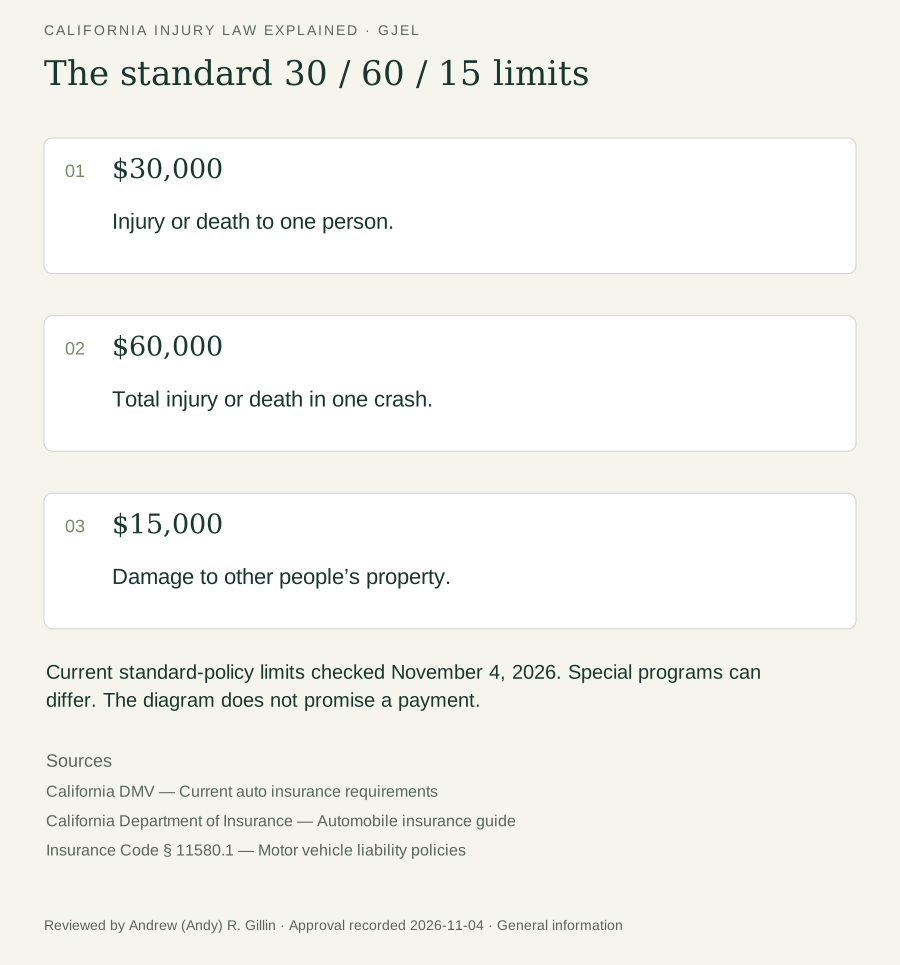
How we record review approvalCalifornia’s standard car policy minimums are often called 30/60/15. That means $30,000 for injury or death to one person. It means $60,000 for all injury or death in one crash, and $15,000 for property damage. These limits do not promise a payment.
In this guide
Here’s an example
Two people are hurt in a crash. The at-fault driver has a standard policy with the minimum limits. They must check the limit for each person. They must also check the total injury limit for the crash.
A made-up example to explain the idea. Your facts may lead to a different answer.How the rule works
This type of coverage pays for covered harm you cause to others. A policy limit caps what it may pay. You still need proof of fault and loss.
Legal references: [1] California DMV — Current auto insurance requirements · [2] California Department of Insurance — Automobile insurance guide · [3] Insurance Code § 11580.1 — Motor vehicle liability policies
The standard 30 / 60 / 15 limits
$30,000
Injury or death to one person.
$60,000
Total injury or death in one crash.
$15,000
Damage to other people’s property.
Current standard-policy limits checked November 4, 2026. Special programs can differ. The diagram does not promise a payment.
Read the three numbers separately
The first number is the injury-or-death limit for one person. The second is the total for the crash. The third is for harm to property. It is not extra money for an injury.
These standard minimums took effect for policies issued or renewed starting in 2025. Old articles may show lower amounts. Do not use an old web page in place of the policy that applied on the event date.
What if the loss is more than the limit?
A policy limit and the amount of harm are different. A low limit may lead you to check other people who shared fault. Check other policies too. Your own UIM coverage may be one source to review.
The Waller case explains why the policy’s terms matter. It does not set the dollar limits. The state’s current statute and agency guides are the sources for those limits.
If the other policy may be too small, read underinsured motorist coverage.
For the role of your own policy, compare liability-only coverage.
What can change the answer?
Special low-cost programs may have other limits. A work trip or rideshare trip can raise more rules. Check the date, the full policy, and any other coverage.
Questions people ask
Does meeting the minimum mean my own injuries are covered?
No. Liability coverage has a different purpose from first-party injury coverage. Check UM, UIM, medical payments, and health coverage separately.
Court decisions behind this answer
A case can help explain a rule. Its facts and limits matter too.
Waller v. Truck Ins. Exchange, Inc.
Supreme Court of California · 1995
11 Cal.4th 1, pp. 18–19
The court read the policy to decide if a loss might be covered. What the contract says matters.
This was a business policy. It does not show what your own car policy pays.
Case applicability reviewed as recorded above.
A useful next step
Get the coverage page and full policy. Check the policy in force on the crash date and all possible sources of payment.
If you are unsure which rule applies, a lawyer can review your facts and any deadlines. Learn about GJEL’s injury representation.
The law behind this guide
The references below support the legal discussion. Their application depends on the facts.
- California DMV — Current auto insurance requirements ↗Agency guidance · Review recorded above
- California Department of Insurance — Automobile insurance guide ↗Agency guidance · Review recorded above
- Insurance Code § 11580.1 — Motor vehicle liability policies ↗Statute · Review recorded above
- Waller v. Truck Ins. Exchange, Inc. (1995) 11 Cal.4th 1 ↗Case law · Review recorded above
- Insurance Code § 11580.2 — Uninsured motorist coverage ↗Statute · Review recorded above
- California Department of Insurance — Standard minimums effective in 2025 ↗Agency guidance · Review recorded above
Updated 2026-11-04. Read our editorial standards.