Does lane splitting mean a motorcycle rider is at fault?
Reviewed by Andrew (Andy) R. Gillin
California State Bar #45226 ↗ · Approval recorded November 4, 2026
How we record review approvalLane splitting is legal in California. It does not, by itself, make a rider at fault in a crash. How the rider and other drivers acted still matters.
In this guide
Here’s an example
A rider moves between lanes. A driver then makes a sudden unsafe lane change into the rider’s path.
A made-up example to explain the idea. Your facts may lead to a different answer.How the rule works
The law defines lane splitting, but does not make every ride safe. As in other crash claims, speed and care matter. The acts of each road user need to be reviewed together.
Legal references: [1] Vehicle Code § 21658.1 — Motorcycle lane splitting · [4] California Highway Patrol — Lane splitting and motorcycle safety · [3] Li v. Yellow Cab Co. (1975) 13 Cal.3d 804
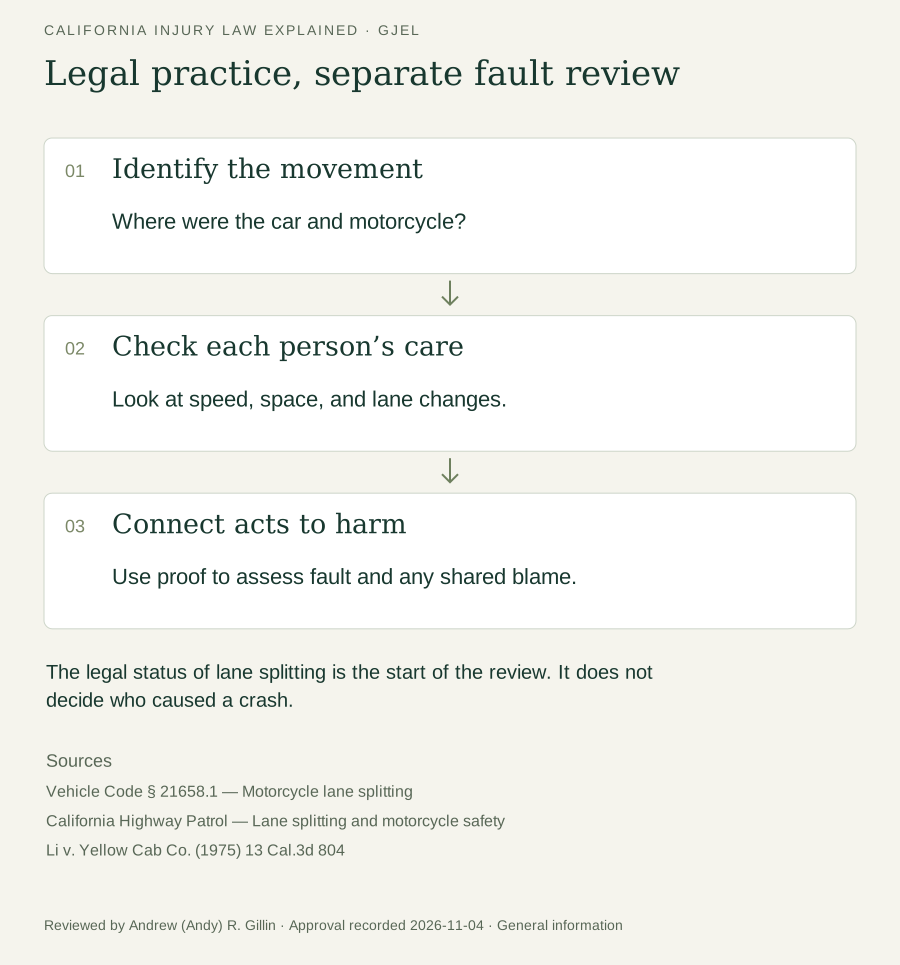
Legal practice, separate fault review
Identify the movement
Where were the car and motorcycle?
Check each person’s care
Look at speed, space, and lane changes.
Connect acts to harm
Use proof to assess fault and any shared blame.
The legal status of lane splitting is the start of the review. It does not decide who caused a crash.
Is lane splitting legal in California?
Yes. State law defines lane splitting as riding a motorcycle between rows of stopped or moving vehicles in the same lane. The Highway Patrol also gives safety guidance.
The fact that the practice is legal does not make every pass safe. Road space, speed, sight lines, and other traffic can matter. Do not treat a safety tip as a promise that a crash cannot happen.
Speed and road conditions can raise separate questions. See unsafe speed and crash fault.
What facts matter after a crash?
Keep proof of where the bike and car were before contact. A lane change, an opening door, a blocked path, or an unsafe pass may matter. Photos and witness accounts can help explain the scene.
A rider and driver can share blame. The Li rule helps explain how shared fault can reduce damages in a covered negligence claim. It does not assign blame based only on the type of vehicle.
If both sides may share blame, read comparative fault in California.
To preserve the facts, use what evidence to save.
What can change the answer?
Speed, traffic, and what each person could see can affect fault. Not every way of riding between lanes is safe.
Questions people ask
Does lane splitting give a rider automatic right of way?
Do not treat it as a guarantee that another driver must pay after a crash. Each person’s care and the cause of harm still need review.
Is riding on the shoulder the same thing?
No. Highway Patrol guidance says shoulder riding is not lane splitting. Do not use lane-splitting rules as permission to ride on the shoulder.
References: [4]
Court decisions behind this answer
A case can help explain a rule. Its facts and limits matter too.
Li v. Yellow Cab Co.
Supreme Court of California · 1975
13 Cal.3d 804, pp. 827–829
A person can share fault and still have a negligence claim. Their share of blame can reduce the recovery.
This case supports comparative fault. It does not set lane-splitting speed rules or decide that a particular ride was safe.
Case applicability reviewed as recorded above.
A useful next step
Save video and witness names. Keep proof of traffic speed and how the vehicles moved.
If you are unsure which rule applies, a lawyer can review your facts and any deadlines. Learn about GJEL’s injury representation.
The law behind this guide
The references below support the legal discussion. Their application depends on the facts.
- Vehicle Code § 21658.1 — Motorcycle lane splitting ↗Statute · Review recorded above
- CACI No. 400–401 — Negligence and the standard of care (2026 edition) ↗Jury instructions · Review recorded above
- Li v. Yellow Cab Co. (1975) 13 Cal.3d 804 ↗Case law · Review recorded above
- California Highway Patrol — Lane splitting and motorcycle safety ↗Agency guidance · Review recorded above
- California Civil Code § 1714 — Responsibility for harm ↗Statute · Review recorded above
Updated 2026-11-04. Read our editorial standards.