What should I do in the first days after an accident?
Reviewed by Andrew (Andy) R. Gillin
California State Bar #45226 ↗ · Approval recorded November 4, 2026
How we record review approvalGet to safety and seek medical care as needed. Then save facts about the event. Check which reports and claims have time limits.
In this guide
Here’s an example
After getting care, a person saves crash photos. They also tell their own insurer what happened.
A made-up example to explain the idea. Your facts may lead to a different answer.How the rule works
The early goal is to protect your health and keep facts from being lost. Memories fade, video gets erased, and repairs change a scene. Taking simple notes can help keep a clear record.
Legal references: [1] California Department of Insurance — Automobile insurance guide · [2] California Courts — Civil lawsuits
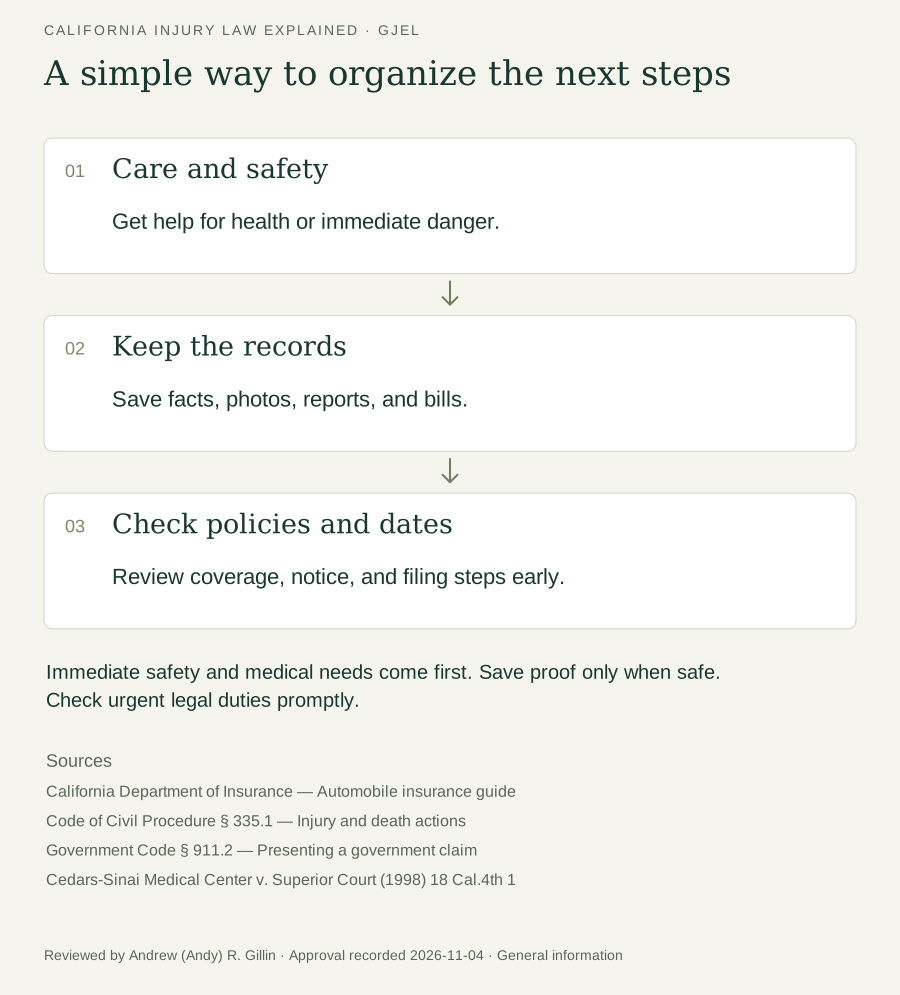
A simple way to organize the next steps
Care and safety
Get help for health or immediate danger.
Keep the records
Save facts, photos, reports, and bills.
Check policies and dates
Review coverage, notice, and filing steps early.
Immediate safety and medical needs come first. Save proof only when safe. Check urgent legal duties promptly.
Keep care, reports, and proof in order
Put health and immediate safety first. Ask a health professional about symptoms or care. This guide cannot tell you whether you are injured or what treatment you need.
When safe, keep photos, witness details, the other driver’s information, and copies of reports. Save original files and make copies for sharing. Do not put yourself at risk to collect evidence.
For a practical list of records, use the evidence checklist.
A report is one part of the facts. Read how a police report fits a claim.
Check coverage and dates early
Find your auto policy and ask about notice duties. Keep a list of claim numbers and who called. Say what you know and avoid guessing about fault or the full effect of an injury.
Check the lawsuit and any government-claim dates while records are being gathered. A slow insurance review does not make other deadlines stop. Keep letters in date order so you can see what has been requested.
For claim conversations, read talking with an adjuster.
Before waiting on an offer, check the different deadline clocks.
What can change the answer?
The right steps depend on what happened. If symptoms are serious or get worse, seek medical help. Do not wait on a web guide.
Questions people ask
Court decisions behind this answer
A case can help explain a rule. Its facts and limits matter too.
Cedars-Sinai Medical Center v. Superior Court
Supreme Court of California · 1998
18 Cal.4th 1, pp. 8–13
The court discussed evidence rules and case sanctions as responses to lost evidence in the setting before it.
This case supports the evidence-preservation part of this guide. It does not give medical advice or decide when a person should seek care.
Case applicability reviewed as recorded above.
A useful next step
Keep care records, receipts, and claim details in one place. Write down the names of people who were there.
If you are unsure which rule applies, a lawyer can review your facts and any deadlines. Learn about GJEL’s injury representation.
The law behind this guide
The references below support the legal discussion. Their application depends on the facts.
- California Department of Insurance — Automobile insurance guide ↗Agency guidance · Review recorded above
- California Courts — Civil lawsuits ↗Court guidance · Review recorded above
- Cedars-Sinai Medical Center v. Superior Court (1998) 18 Cal.4th 1 ↗Case law · Review recorded above
- Civil Code § 3333 — Compensation for harm ↗Statute · Review recorded above
- Code of Civil Procedure § 335.1 — Injury and death actions ↗Statute · Review recorded above
- Government Code § 911.2 — Presenting a government claim ↗Statute · Review recorded above
Updated 2026-11-04. Read our editorial standards.