What losses can a wrongful-death claim cover?
Reviewed by Andrew (Andy) R. Gillin
California State Bar #45226 ↗ · Approval recorded November 4, 2026
How we record review approvalSome survivors may claim money for lost support and loss of a loved one’s care and company. These are called wrongful-death damages. The law limits which losses the claim can cover. Proof still matters.
In this guide
Here’s an example
A family loses income and help at home after a parent dies. They lose the parent’s care and company too. They ask which losses the claim may cover and what proof is needed.
A made-up example to explain the idea. Your facts may lead to a different answer.How the rule works
The claim may cover lost support, help at home, and some costs of a funeral or burial. It may also cover lost care, guidance, and companionship. Who may sue is a separate question.
Legal references: [1] Code of Civil Procedure § 377.60 — Wrongful death claims · [2] Code of Civil Procedure § 377.61 — Wrongful death damages · [3] CACI No. 3921 — Wrongful death of an adult (2026 edition)
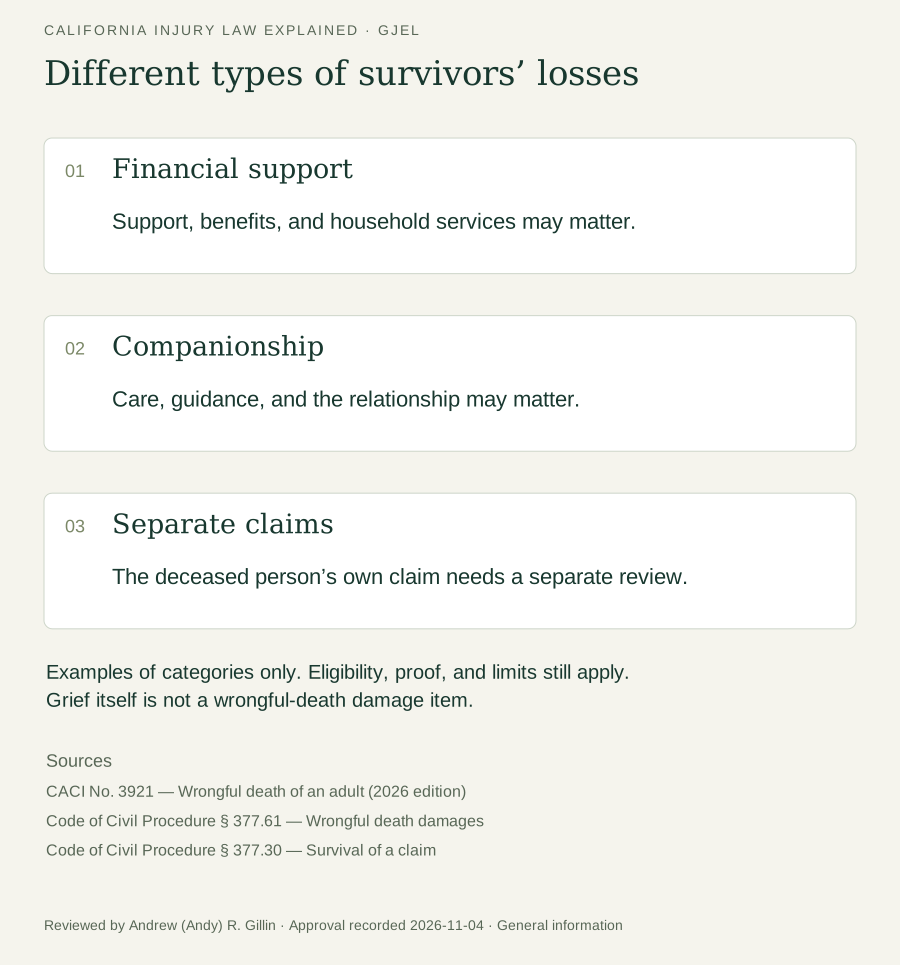
Different types of survivors’ losses
Financial support
Support, benefits, and household services may matter.
Companionship
Care, guidance, and the relationship may matter.
Separate claims
The deceased person’s own claim needs a separate review.
Examples of categories only. Eligibility, proof, and limits still apply. Grief itself is not a wrongful-death damage item.
What proof helps with financial loss?
Income records can help explain support. A clear account of work at home can also matter. Keep funeral and burial bills. Do not assume that a salary alone describes all of the loss.
A future-loss claim needs a reasoned basis. It cannot rest only on a guessed total. A lawyer may need other records or expert work to explain the amount and time period.
Before valuing the claim, check who may bring a wrongful-death claim.
Why are companionship and grief different?
The claim may cover the care, help, and company the person would have provided. Grief and sorrow are a different legal category. Krouse explains why courts keep these things apart.
The deceased person’s own claim is different from the survivors’ losses. A survival claim has separate rules. A separate emotional-harm claim also needs its own facts and legal basis.
To keep the claims distinct, read the difference between wrongful death and survival.
What can change the answer?
Grief itself and the person’s pain before death are not wrongful-death damages. A separate claim may raise other rules. Future losses and claims by several survivors need careful review.
Court decisions behind this answer
A case can help explain a rule. Its facts and limits matter too.
Krouse v. Graham
Supreme Court of California · 1977
19 Cal.3d 59, pp. 67–72
The court distinguished loss of a loved one’s companionship from grief itself in a wrongful-death claim.
The case also discussed a separate emotional-harm claim. The rules for that claim need their own review.
Case applicability reviewed as recorded above.
A useful next step
Keep records of support, household work, and costs. Ask who may claim each loss and how the different claims fit together.
If you are unsure which rule applies, a lawyer can review your facts and any deadlines. Learn about GJEL’s injury representation.
The law behind this guide
The references below support the legal discussion. Their application depends on the facts.
- Code of Civil Procedure § 377.60 — Wrongful death claims ↗Statute · Review recorded above
- Code of Civil Procedure § 377.61 — Wrongful death damages ↗Statute · Review recorded above
- CACI No. 3921 — Wrongful death of an adult (2026 edition) ↗Jury instructions · Review recorded above
- Krouse v. Graham (1977) 19 Cal.3d 59 ↗Case law · Review recorded above
- Code of Civil Procedure § 377.30 — Survival of a claim ↗Statute · Review recorded above
Updated 2026-11-04. Read our editorial standards.