Why is my settlement different from what I take home?
Reviewed by Andrew (Andy) R. Gillin
California State Bar #45226 ↗ · Approval recorded November 4, 2026
How we record review approvalThe total settlement may be more than the amount you keep. Fees, case costs, unpaid bills, and valid repayment claims may come out of it.
In this guide
Here’s an example
A written breakdown shows the full payment. It then lists fees, costs, and medical sums that must be repaid.
A made-up example to explain the idea. Your facts may lead to a different answer.How the rule works
Ask to see the gross amount and net amount. Gross means the total before deductions. Net means what remains after them. Check fees, costs, bills, and repayment claims separately.
Legal references: [1] Business and Professions Code § 6147 — Contingency fee agreements · [2] California Department of Insurance — Automobile insurance guide
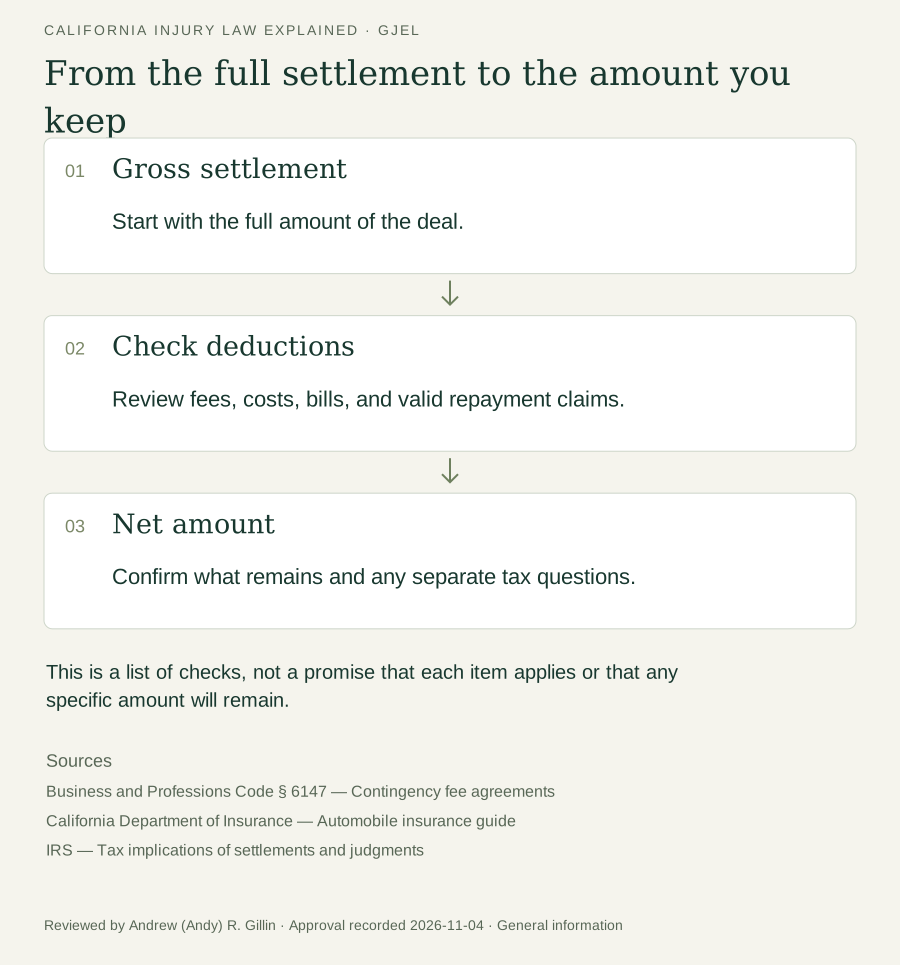
From the full settlement to the amount you keep
Gross settlement
Start with the full amount of the deal.
Check deductions
Review fees, costs, bills, and valid repayment claims.
Net amount
Confirm what remains and any separate tax questions.
This is a list of checks, not a promise that each item applies or that any specific amount will remain.
Ask for a clear list of deductions
Start with the gross amount: the full settlement. Then list fees, case costs, bills, and any valid repayment claims. The net amount is what remains. Ask which items are final and which are still being checked.
A medical bill, a lien, and an insurer’s repayment claim are not always the same thing. The right to repayment and the amount may depend on the plan, law, and facts. Do not assume each request is valid or that each can be ignored.
For how bills may be paid before a settlement, read medical bills while the claim is open.
For the fee side, compare fees and case costs.
Keep tax questions separate
Tax treatment is a separate check. It can depend on what each part of a settlement pays for. Do not assume that every payment has the same tax result. Ask a qualified tax adviser to review the documents.
Sources: [5]
For a starting explanation, read GJEL’s overview of taxes on a recovery ↗.
What can change the answer?
The terms of your fee agreement and bills matter. So do valid liens and repayment rights. A total offer is not a promise of take-home pay.
Court decisions behind this answer
A case can help explain a rule. Its facts and limits matter too.
Fergus v. Songer
California Court of Appeal · 2007
150 Cal.App.4th 552, slip op., p. 3 & fn. 1
The fee contract lacked a term the law required. The court discussed what that meant for the lawyer’s fee.
This does not set GJEL’s fee or erase every possible fee claim. Read the agreement and current law.
Howell v. Hamilton Meats & Provisions, Inc.
Supreme Court of California · 2011
52 Cal.4th 541, slip op., pp. 1–2
For the insured care at issue, a bill’s unpaid negotiated writeoff was not a loss the patient could recover.
This does not decide every bill or lien. Future care and other kinds of loss need separate proof.
Case applicability reviewed as recorded above.
A useful next step
Ask for a written breakdown. Have each deduction explained before the money is paid out.
If you are unsure which rule applies, a lawyer can review your facts and any deadlines. Learn about GJEL’s injury representation.
The law behind this guide
The references below support the legal discussion. Their application depends on the facts.
- Business and Professions Code § 6147 — Contingency fee agreements ↗Statute · Review recorded above
- California Department of Insurance — Automobile insurance guide ↗Agency guidance · Review recorded above
- Fergus v. Songer (2007) 150 Cal.App.4th 552 ↗Case law · Review recorded above
- Howell v. Hamilton Meats & Provisions, Inc. (2011) 52 Cal.4th 541 ↗Case law · Review recorded above
- IRS — Tax implications of settlements and judgments ↗Agency guidance · Review recorded above
Updated 2026-11-04. Read our editorial standards.